
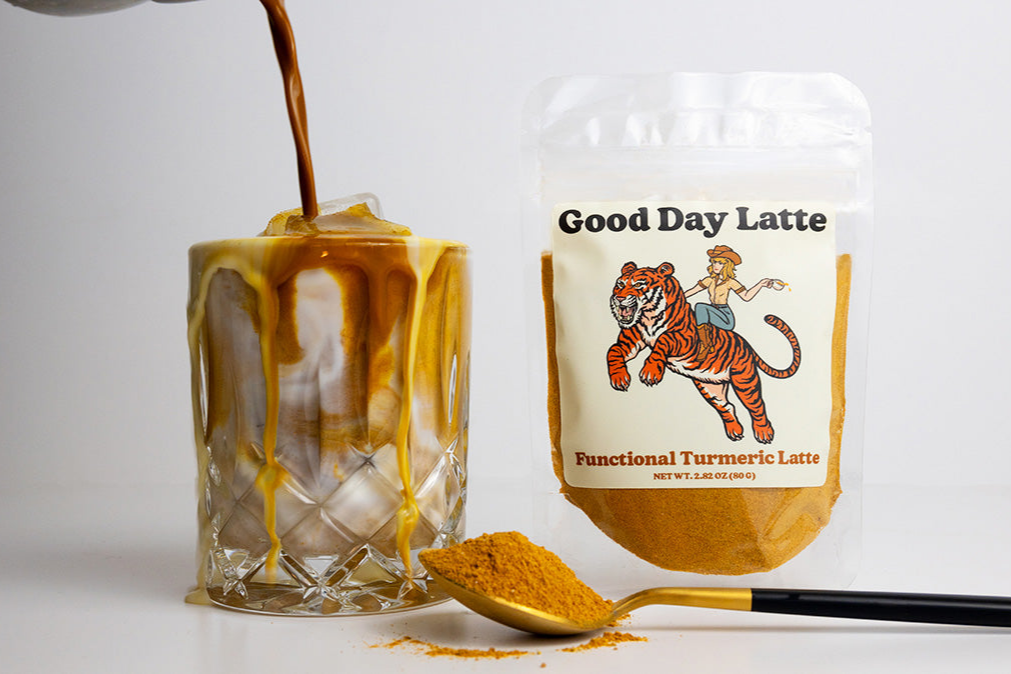

Coffee works. Until it doesn’t.
For a while, coffee feels like the perfect system — quick, effective, reliable.
Then one day it’s:
• a little jittery
• a little anxious
• a little too much
Usually somewhere between the second cup and mid-afternoon.
That’s where people start looking for alternatives. And turmeric lattes tend to show up pretty quickly.
But most of the conversation around them is… incomplete.
What a turmeric latte actually is
At its core, a turmeric latte (or “golden milk”) is just turmeric plus spices — usually ginger, cinnamon, maybe cardamom — mixed into milk.
It’s been around for a long time in traditional practices, and the main compound in turmeric — curcumin — has been studied pretty extensively for its antioxidant activity and interaction with the body’s inflammatory pathways.
So yes, turmeric is interesting.
But it’s also not the whole story.
Turmeric isn’t the “energy” — and that’s where people get confused
If you’re expecting turmeric to feel like coffee, you’re going to be disappointed.
It’s not a stimulant. It doesn’t “hit.” It’s not supposed to.
A lot of turmeric latte content tries to frame it as some kind of caffeine replacement that gives you energy in the same way.
That’s not really accurate.
The experience people are actually responding to usually comes from how turmeric is combined with other ingredients — not turmeric on its own.

The ingredient stack is what actually changes the experience
This is the part most brands gloss over.
Drinks like Good Day Latte are built around a combination of ingredients that have very different roles.
For example:
• Cordyceps has been studied in the context of oxygen utilization and endurance, which is why it shows up in a lot of performance-focused blends
• Lion’s Mane has been researched for its relationship to nerve growth factor (NGF), which is part of why it’s often included in cognitive-focused formulations
• Maca has a long history of traditional use related to stamina and overall vitality
None of these behave like caffeine. There’s no spike, no crash, no forced stimulation.
What you get instead — when they’re combined well — is something people usually describe as:
• more stable
• more even
• less chaotic
That’s a very different category of “energy,” and honestly a better word for it is probably just consistency.
There is real research here — just not in the way people expect
Turmeric itself has been studied quite a bit.
A review published in the journal Foods (2020) highlights curcumin as a bioactive compound with antioxidant properties and notes its widespread interest in nutrition research.
Another review in Advances in Experimental Medicine and Biology explores how curcumin interacts with multiple cellular pathways related to oxidative stress and inflammation.
There’s also well-known research on piperine (from black pepper) increasing curcumin absorption significantly when combined.
None of this means turmeric is a cure-all.
It just means there’s a reason it’s been used consistently for a long time — and why modern formulations still include it.

The ritual is doing more work than you think
This part has nothing to do with compounds or studies.
It’s just behavior.
Taking five minutes to make a drink, sit down, and not immediately spike your system with caffeine changes how your day starts.
For me, this started as a way to not feel completely fried by noon between drumming, work, and running Good Day Latte.
It wasn’t about quitting coffee. It was about having another option that didn’t push everything into overdrive.
That shift alone matters more than most people expect.
Why most turmeric blends don’t hit the same
Not all turmeric lattes feel the same — and that’s usually because they’re not built the same.
You’ll see differences in:
• whether mushrooms are actually fruiting-body or just mycelium fillers
• whether the spices are balanced or just thrown in
• whether it tastes like something you’d actually want to drink daily
At Good Day Latte, the focus is pretty simple:
• real ingredients
• no filler shortcuts
• a formula that actually works as a daily drink
👉 https://gooddaylatte.com/products/turmeric-latte-mix-10-servings
Where to try it
You can make it at home, or find Good Day Latte in select coffee shops that carry it.
👉 https://gooddaylatte.com/blogs/news/good-day-latte-is-now-on-the-menu-at-10-speed-coffee
The takeaway
Turmeric lattes aren’t a miracle drink.
They’re also not coffee.
They’re part of a different category entirely — one that’s less about stimulation and more about keeping things steady.
Some days you want intensity.
Some days you don’t.
That’s it.
Spice boldly. Sip calmly.
About the Author
Corey Coverstone is the founder of Good Day Latte and a professional drummer. He created Good Day Latte as a way to build a more balanced daily ritual without relying entirely on caffeine.

Corey Coverstone, founder of Good Day Latte (and frequent drinker of it)
Share:
Hand Craft Coffee ⚡ Good Day Latte